 Tempusxr
- Documentation
- Exemples de suivi d'images
Gestion des événements
Tout ce que le SDK dit à la page : la caméra tourne, une image est trouvée, une image est perdue, une erreur arrive. Cette page les affiche à l'écran, pour les voir pendant que vous bougez le téléphone.
Essayer
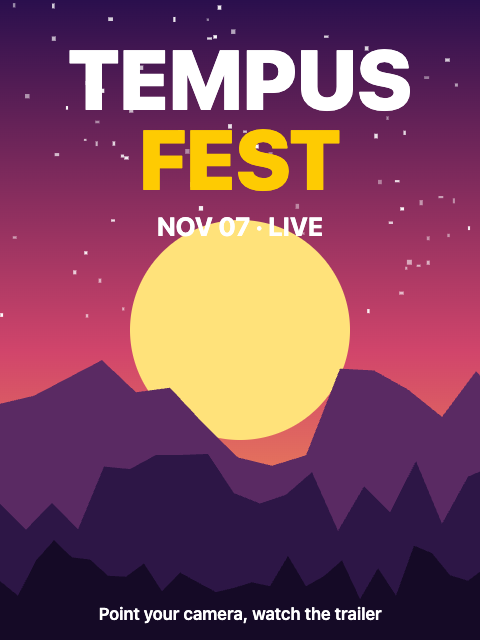
Ouvrez les démos sur un téléphone : la caméra a besoin d'une page sécurisée. Puis visez l'image ci-dessous, affichée sur un second écran ou imprimée.
A-Frame
La scène émet tempusxr-ready et tempusxr-error. Chaque entité cible émet targetFound et targetLost, avec l'ancre dans event.detail.
<!doctype html>
<html lang="en">
  <head>
    <meta charset="utf-8" />
    <meta name="viewport" content="width=device-width, initial-scale=1, viewport-fit=cover" />
    <title>Events handling (A-Frame)</title>
    <!-- A-Frame, Tempusxr and the image tracker, as plain script tags. -->
    <script src="/node_modules/aframe/dist/aframe-v1.8.0.min.js"></script>
    <script src="/packages/sdk-aframe/dist/index.umd.cjs"></script>
    <script src="/packages/sdk-tracker-image/dist/index.umd.cjs"></script>
    <style>
      #log {
        position: fixed;
        left: 12px;
        right: 12px;
        bottom: 12px;
        z-index: 10;
        max-height: 30vh;
        margin: 0;
        padding: 8px 12px;
        overflow: hidden;
        border-radius: 10px;
        background: rgba(0, 0, 0, 0.6);
        color: #fff;
        font:
          13px/1.5 ui-monospace,
          Menlo,
          monospace;
        pointer-events: none;
      }
    </style>
  </head>
  <body>
    <!-- Show poster.png, then look away: the page logs what the SDK tells it. -->
    <pre id="log"></pre>

    <a-scene
      tempusxr="tracker: image; targets: /examples/poster-video/poster.txr"
      renderer="alpha: true"
      vr-mode-ui="enabled: false"
    >
      <a-camera></a-camera>
      <a-light type="ambient" intensity="1"></a-light>
      <a-entity id="target" tempusxr-image-target="index: 0">
        <a-box position="0 0 0.15" scale="0.3 0.3 0.3" color="#fecb02"></a-box>
      </a-entity>
    </a-scene>

    <script>
      const lines = [];
      const log = (text) => {
        lines.push(`${new Date().toLocaleTimeString()}  ${text}`);
        document.getElementById('log').textContent = lines.slice(-6).join('\n');
      };
      const scene = document.querySelector('a-scene');
      const target = document.getElementById('target');
      scene.addEventListener('tempusxr-ready', () => log('tempusxr-ready: camera and tracker run'));
      scene.addEventListener('tempusxr-error', (event) =>
        log(`tempusxr-error: ${event.detail.error.message}`),
      );
      target.addEventListener('targetFound', () => log('targetFound'));
      target.addEventListener('targetLost', () => log('targetLost'));
    </script>
  </body>
</html>
Three.js
ar.on(nom, fonction) renvoie une fonction qui arrête l'écoute. Les noms sont camera, found, lost et error.
<!doctype html>
<html lang="en">
  <head>
    <meta charset="utf-8" />
    <meta name="viewport" content="width=device-width, initial-scale=1, viewport-fit=cover" />
    <title>Events handling (Three.js)</title>
    <!-- Three.js with the SDK, as a page without a bundler loads it. -->
    <script type="importmap">
      {
        "imports": {
          "three": "/node_modules/three/build/three.module.js",
          "@tempusxr/sdk-core": "/packages/sdk-core/dist/index.js",
          "@tempusxr/sdk-three": "/packages/sdk-three/dist/index.js",
          "@tempusxr/sdk-tracker-image": "/packages/sdk-tracker-image/dist/index.js"
        }
      }
    </script>
    <style>
      html,
      body {
        margin: 0;
        height: 100%;
        background: #111;
      }
      #log {
        position: fixed;
        left: 12px;
        right: 12px;
        bottom: 12px;
        z-index: 10;
        max-height: 30vh;
        margin: 0;
        padding: 8px 12px;
        overflow: hidden;
        border-radius: 10px;
        background: rgba(0, 0, 0, 0.6);
        color: #fff;
        font:
          13px/1.5 ui-monospace,
          Menlo,
          monospace;
        pointer-events: none;
      }
    </style>
  </head>
  <body>
    <!-- Show poster.png, then look away: the page logs what the SDK tells it. -->
    <pre id="log"></pre>
    <div id="ar"></div>
    <script type="module">
      import * as THREE from 'three';
      import { create } from '@tempusxr/sdk-three';
      import '@tempusxr/sdk-tracker-image';

      const lines = [];
      const log = (text) => {
        lines.push(`${new Date().toLocaleTimeString()}  ${text}`);
        document.getElementById('log').textContent = lines.slice(-6).join('\n');
      };

      const ar = create({ container: '#ar' });
      window.__ar = ar;
      const tracker = await ar.use('image', { targets: ['/examples/poster-video/poster.txr'] });

      const box = new THREE.Mesh(
        new THREE.BoxGeometry(0.3, 0.3, 0.3),
        new THREE.MeshBasicMaterial({ color: '#fecb02' }),
      );
      box.position.z = 0.15;
      const content = new THREE.Group();
      content.add(box);
      ar.attach(tracker.anchors[0], content);

      ar.on('camera', () => log('camera: the camera runs'));
      ar.on('found', (anchor) => log(`found: target ${anchor.targetIndex}`));
      ar.on('lost', (anchor) => log(`lost: target ${anchor.targetIndex}`));
      ar.on('error', (error) => log(`error: ${error.message}`));

      await ar.start();
    </script>
  </body>
</html>
À retenir
- Une cible n'est perdue qu'après quelques images sans elle : un flou court ne fait donc pas clignoter le contenu.
- Utilisez ces événements pour lancer une vidéo, jouer un son ou envoyer une statistique.